Dinosaur biogeographical networks
Our new paper, “Dinosaur biogeographical structure and Mesozoic continental fragmentation: a network-based approach” is published as a Special Paper in Journal of Biogeography today. Read the article (or just the abstract if you don’t have a subscription) here. Email me @ a.dunhill@leeds.ac.uk if would like me to send you the PDF.
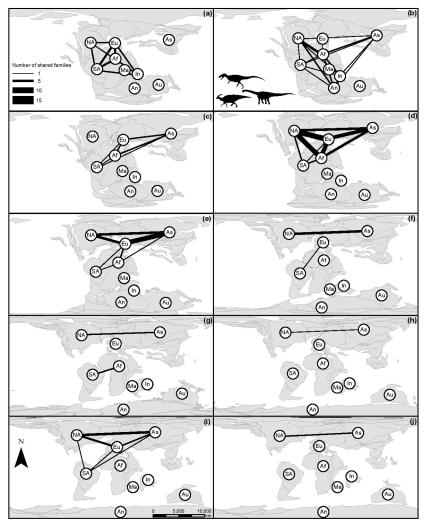
Together with Jordan Bestwick (Leicester), Holly Narey (Bath) and James Sciberras (Bath), I used an application of network theory to map and quantify dinosaur macro-biogeographical structure and compared it to continental fragmentation and dinosaurian evolutionary rates throughout the Mesozoic. Our main findings are:
- Geographical connectedness declines through time.
- Biogeographical connectedness shows no common trend, and varies regarding the parameters of the network models.
- Despite continental isolation and high sea levels, the exchange of dinosaur families continues, at a reduced rate, right to the end of the Cretaceous.
- There is some evidence that increased biogeographical isolation led to increased dinosaur origination.
- We see a resurgence of biogeographical connectedness in the Late Cretaceous (Campanian) despite high sea levels.
- We see an apparent “exodus of Europe” in the Early Cretaceous (Aptian-Albian) where all European connections are outgoing.
- Dinosaur macro-biogeographical patterns are obscured by uneven geographical sampling through time and a residual earlier Mesozoic distribution which is sustained up to the end of the Cretaceous.
The study has received media interest from a number of news outlets, with the UK media seizing the opportunity to report on a “European exit”!
See MailOnline & Telegraph
This study was funded by the Royal Commission for the Exhibition of 1851.
 DeepBio@Leeds