New paper out in Proceedings of the National Academy of Sciences by Haijun Song et al. entitled “Flat latitudinal diversity gradient caused by the Permian–Triassic mass extinction”.
Marine biodiversity patterns changed rapidly during the Permian-Triassic mass extinction, altering the latitudinal diversity gradient for 5 million years, a study finds. In PNAS: https://t.co/ykCvpkoO1K pic.twitter.com/Wtz4hDYKaA
— PNASNews (@PNASNews) July 8, 2020
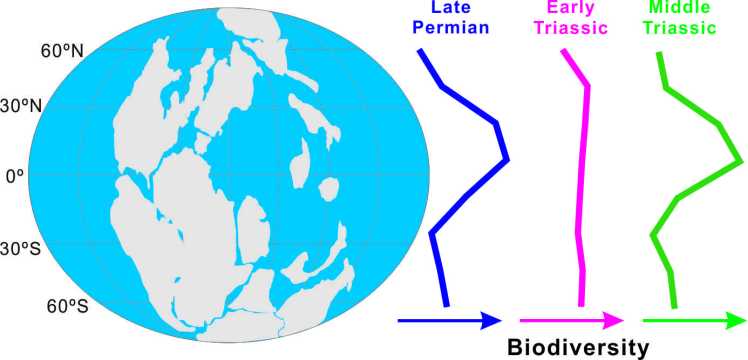
Out study showed that marine biodiversity patterns changed rapidly during the Permian-Triassic mass extinction, altering the latitudinal diversity gradient for 5 million years. Our results suggest that climatic stability and the collapse of tropical reef ecosystems in response to extreme Early Triassic equatorial temperatures seemed to be key for driving the LDG, perhaps more so than just prevailing greenhouse/icehouse climate regimes alone.
See below for the article abstract and significance sections and read the full article here:
Abstract: The latitudinal diversity gradient (LDG) is recognized as one of the most pervasive, global patterns of present-day biodiversity. However, the controlling mechanisms have proved difficult to identify because many potential drivers covary in space. The geological record presents a unique opportunity for understanding the mechanisms which drive the LDG by providing a direct window to deep-time biogeographic dynamics. Here we used a comprehensive database containing 52,318 occurrences of marine fossils to show that the shape of the LDG changed greatly during the Permian–Triassic mass extinction from showing a significant tropical peak to a flattened LDG. The flat LDG lasted for the entire Early Triassic (∼5 My) before reverting to a modern-like shape in the Middle Triassic. The environmental extremes that prevailed globally, especially the dramatic warming, likely induced selective extinction in low latitudes and accumulation of diversity in high latitudes through origination and poleward migration, which combined together account for the flat LDG of the Early Triassic.
Significance: The deep-time dynamics of the latitudinal diversity gradient (LDG), especially through dramatic events like mass extinctions, can provide invaluable insights into the biotic responses to global changes, yet they remain largely underexplored. Our study shows that the shape of marine LDGs changed substantially and rapidly during the Permian–Triassic mass extinction from a modern-like steep LDG to a flat LDG. The flat LDG lasted for ∼5 My and was likely a consequence of the extreme global environment, including extreme warming and ocean anoxia, which ensured harsh conditions prevailing from the tropics to the poles. Our findings highlight the fundamental role of environmental variations in concert with severe biodiversity loss in shaping the first-order biogeographic patterns.
 DeepBio@Leeds