There have been 2 new mass extinction papers from the lab published in last couple of months…
Firstly, a palaeoecological study of the long benthic recovery from the Toarcian (Early Jurassic) mass extinction event in the Cleveland Basin in North Yorkshire (UK) published in Journal of the Geological Society of London.
Atkinson et al. are the first to document and quantify the full extent and nature of the recovery interval from the Toarcian extinction in the Cleveland Basin. They show that low oxygen levels inhibited recovery for some time before sea floor ventilation facilitated a protracted, stepwise recovery of benthic communities that lasted upwards of 7 million years.
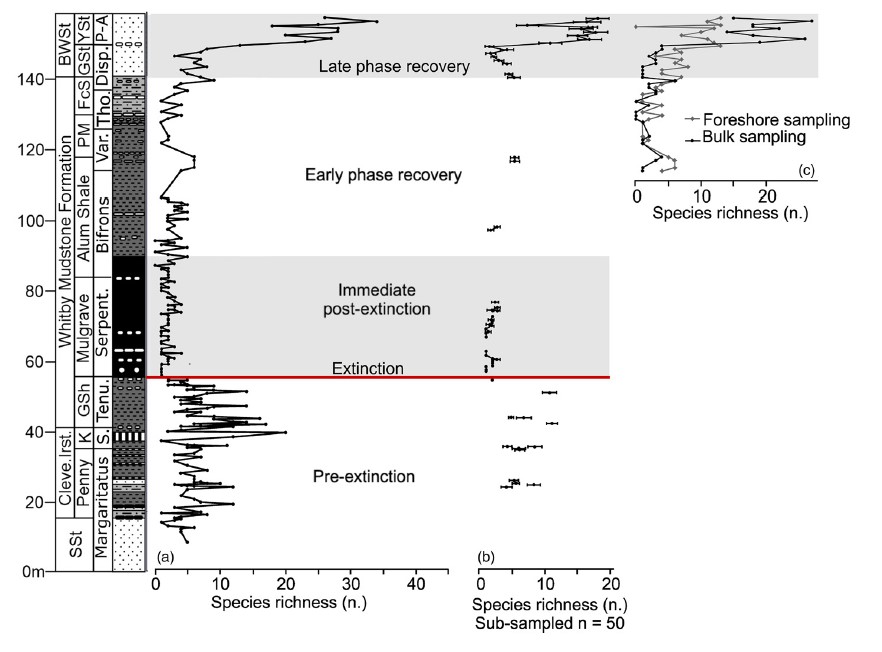
These results show that the recovery from the Toarcian extinction, at least regionally within the low oxygen facies of NW Tethys, was on a par with that of the largest mass extinction event, i.e. the Permo-Triassic mass extinction.
Read more here: Atkinson, J., Little, C.T.S, and Dunhill, A.M. (2022) Long duration of benthic ecological recovery from the early Toarcian (Lower Jurassic) mass extinction event in the Cleveland Basin, UK. Journal of the Geological Society of London. https://www.lyellcollection.org/doi/10.1144/jgs2022-126
Secondly, former lab member Dr Bethany Allen published the centrepiece of her PhD thesis, testing how well we are able to estimate differences in origination and extinction rates across space with popular diversity metrics, using simulations and a Permo-Triassic marine invertebrate case study. This paper was published in Paleobiology.
Allen et al. are the first to test how well commonly used evolutionary rate metrics perform when applied to spatially restricted data sets using a novel simulation approach. They then also applied these metrics to a case study of the marine invertebrate fossil record of the Permian and Triassic to examine how extinction and origination rates varied with latitude across the most catastrophic mass extinction of the Phanerozoic, the Permo-Triassic mass extinction.
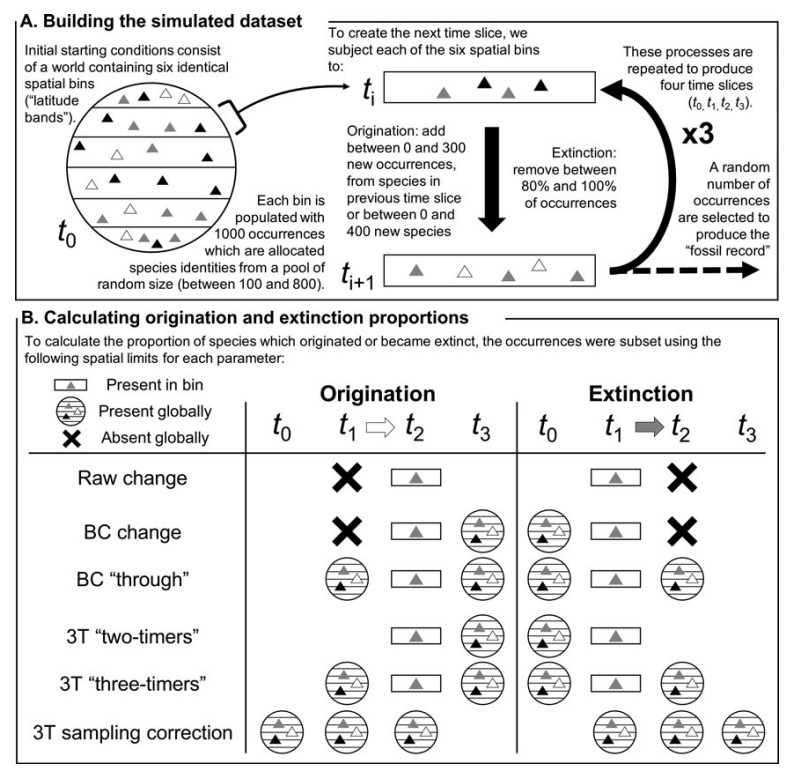
Results suggest that extinction and origination rates were fairly consistent across latitudes throughout the Permian and Triassic and were consistently very high across the Permo-Triassic mass extinction and surprisingly low across the lesser known Capitanian extinction. Results suggest that origination and extinction levels were more variable across clades than across latitudes.
See below for an in-depth summary of this paper from Dr Allen’s Twitter account (@bethany_j_allen)…
Read more here: Allen, B.J., Clapham, M.E., Saupe, E.E., Wignall, P.B., Hill, D.J., and Dunhill, A.M. (2023) Estimating spatial variation in origination and extinction in deep time: a case study using the Permian–Triassic marine invertebrate fossil record. Paleobiology, 1-18. doi:10.1017/pab.2023.1
 DeepBio@Leeds