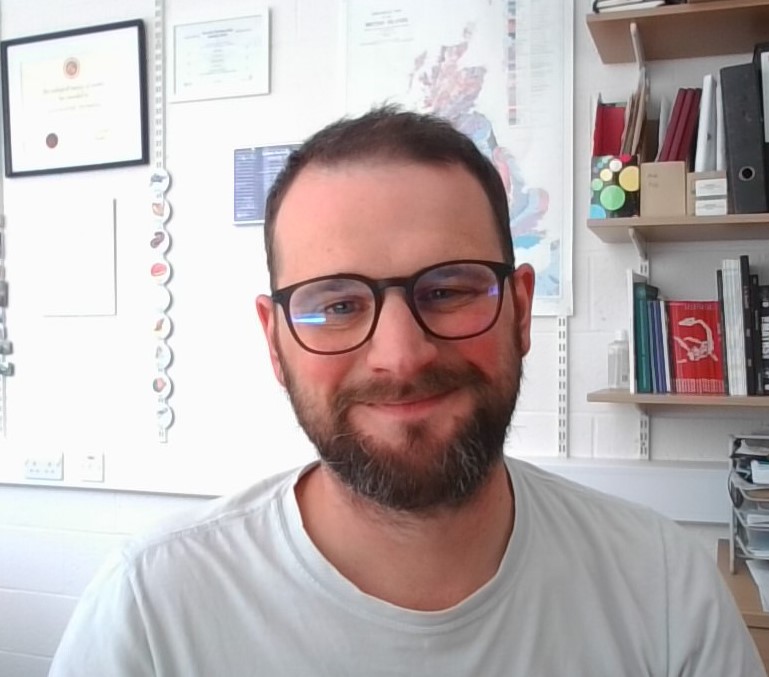
I’m delighted to be awarded the title of PalAss Exceptional Lecturer for the Innovations in Palaeontology Lecture Series 2024/25.
The Innovations in Palaeontology Lecture Series, to be delivered by the PalAss Exceptional Lecturer, aims to promote palaeontology to the wider academic community and to recognize excellence in research among palaeontologists. The PalAss Exceptional Lecturer is selected in a competitive process.

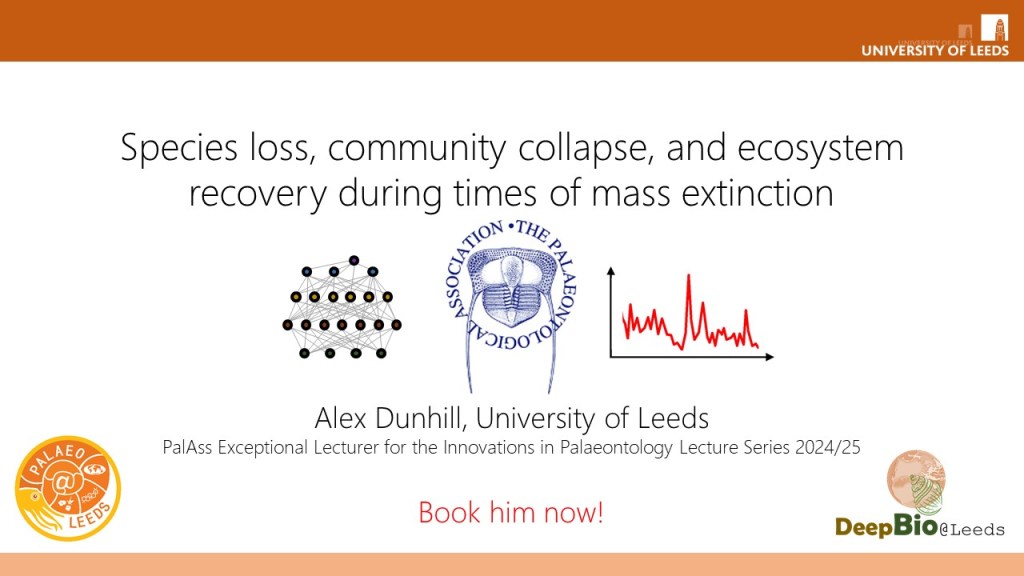
For the series I will be delivering a lecture entitled: Species loss, community collapse, and ecosystem recovery during times of mass extinction.
You can now register interest in hosting me at your institution via the following link: https://www.palass.org/awards-grants/awards/innovations-palaeontology-lecture-series-and-palass-exceptional-lecturer
ABSTRACT: Our planet has suffered repeated mass extinctions that have shaped the evolutionary history of biodiversity through time. Although current state-of-the-art research has given us a thorough understanding of the causes and consequences of mass extinction events, existing research ignores the role of ecosystem structure in providing resilience to environmental change. Ecological theory states that primary extinctions, which are a function of stress type or organism sensitivity, can lead to cascading secondary extinctions where species perish because they are unable to meet energetic requirements from available prey. Extinction selectivity studies always assume extinctions are primary despite ecological theory hinting that many victims of mass extinctions are unlikely to have become extinct as a direct effect of abiotic stress, but probably did so in response to cascading secondary effects. Furthermore, whilst almost all major environmental change events of the Palaeozoic and Mesozoic resulted in catastrophic losses of biodiversity, more recent events in the Cenozoic only lead to modest or no rise at all in extinction rates despite profound environmental changes. A number of Earth system mechanisms have been proposed for the lack of Cenozoic mass extinctions, relating to carbon cycle buffering via supercontinent fragmentation and calcareous nannoplankton evolution. However, it has also been hypothesised that modern community structure was established in the aftermath of the Cretaceous-Paleogene (K/Pg) mass extinction and thus the lack of Cenozoic mass extinctions is a function of increased resilience of marine ecosystems. In this lecture, I will detail the cutting-edge advancements in ecological modelling that I am applying to the fossil record. This is to investigate how marine ecosystem structure changed through the Phanerozoic and whether modern marine ecosystems are more resilient to major disturbance in comparison to ancient communities in an attempt to shed light on the resilience of marine communities to future climatic stress.
 DeepBio@Leeds