The past two months have been a whirlwind of vivas and celebrations. I could not be prouder to share that Amy Shipley, Lydia Woods, Charlotte Clay and Kate Simpson have all passed their PhD vivas with flying colours. Each of them impressed their examiners enormously, and each has produced a thesis that makes a genuine contribution to how we understand life’s history on Earth and, in one case, how we feel about it too.
🦈 Amy Shipley — Megafauna, Megalodon and Marine Food Webs
Amy’s thesis tackled one of the most fascinating events in recent Earth history: the late Pliocene marine megafaunal extinction. At its heart was a simple question — what happens to marine ecosystems when you remove the largest apex predators the oceans have ever seen?
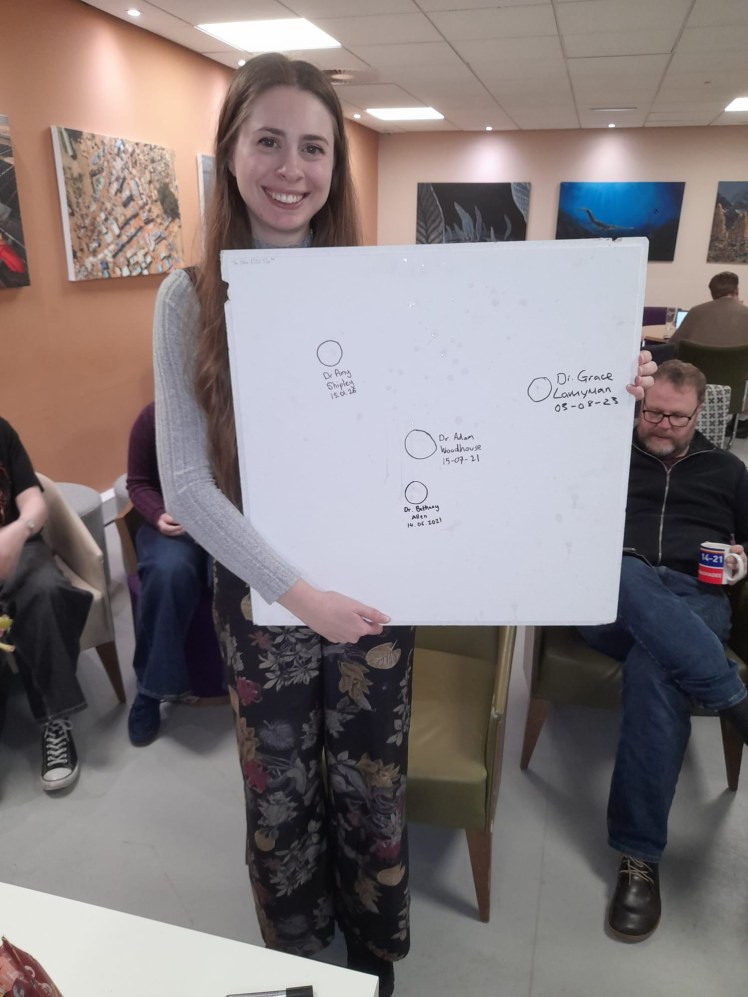
Using innovative and masterfully executed food web modelling, Amy explored the structural consequences of losing Otodus megalodon — quite possibly the largest apex predator to have ever lived. Her work revealed that actually not much happened at the ecosystem-level following the disappearance of these giants, demonstrating how functional redundancy within ecosystems can buffer against the effects of extinction.
She also showed that extinction rates during the late Pliocene were regionally variable, resisting any easy, one-size-fits-all explanation. Crucially, her analyses suggest that no single abiotic driver can be cleanly detected across the event — highlighting the complex, geographically contingent nature of extinction processes.
It’s ambitious, rigorous work that pushes us to think more carefully about both ancient and modern predator loss.
🐚 Lydia Woods — Rethinking Resilience Across Mass Extinction
Lydia’s thesis examined functional and structural diversity in marine ecosystems from the Late Cretaceous to the present day, spanning the K–Pg mass extinction and the entire Cenozoic.
One of her most striking findings is that trophic structure changed remarkably little across the K–Pg boundary, despite catastrophic species losses and that Paleocene and Eocene communities appear structurally near-identical to their Cretaceous predecessors. In other words: ecosystems can retain their structural backbone even when their taxonomic cast is dramatically rewritten.
Her work also exposed a persistent and fascinating disconnection between species diversity and functional diversity across space and through time. Through the Cenozoic, species numbers and ecological roles do not always track one another in intuitive ways — a finding with profound implications for how we measure biodiversity loss today.
Lydia’s thesis reframes resilience, challenging simplistic narratives about collapse and recovery.
🪸 Charlotte Clay — Coral Communities from Deep Time to the Anthropocene
Charlotte’s work bridges palaeontology, ecology and the future of climate change. Her thesis examined functional diversity in coral communities across the Cenozoic, into the present, and forward under climate projections.
Methodologically, she developed innovative trait network approaches for tracking community change across space and time — tools that will be valuable far beyond her own datasets.
Her results are both illuminating and sobering. She demonstrated that Caribbean coral communities are adapted to long-term Cenozoic cooling trends, which leaves them poorly prepared for today’s rapid anthropogenic warming. In other words, evolutionary history matters — and not always in ways that help us.
She also showed that tropicalisation of temperate reefs off Japan is advancing at an alarming pace, and is likely to continue under projected warming scenarios. Charlotte’s thesis connects deep time to urgent contemporary challenges with clarity and power.
📜 Kate Simpson — Poetry, Palaeontology and the Art of “Turning”
And then there is Kate — whose PhD is the most genuinely cross-disciplinary project I’ve ever encountered.
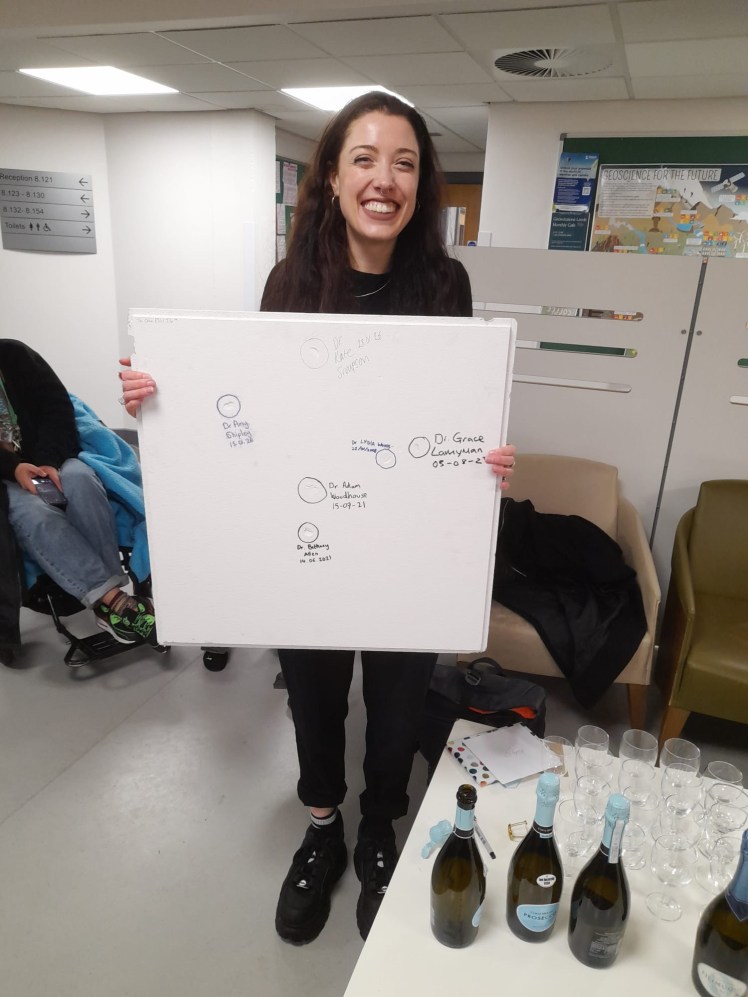
Kate’s practice-led thesis combines poetry and palaeontology to explore how we emotionally engage with Earth’s vast geological timescales. At its core is a long poem that travels backward through major geological eras, reimagining moments of mass extinction and transformation. Alongside it sits a critical commentary unpacking the creative and theoretical methods behind the work.
Together, the project reframes both extinction and poetry as acts of “turning” — not simple endings, but moments of transformation. It asks what it means to encounter deep time not just intellectually, but emotionally.
Kate’s thesis has really expanded what a PhD in our field can look like.
Lots of Pride (and a Little Bit of Sadness)
All four vivas went extremely well. The examiners were impressed, and each thesis passed with only minor or editorial corrections.
Over the past few years, these four researchers have played a central role in the life of our DeepBio@Leeds group. They have supported and challenged one another, and have helped build a strong, thoughtful research environment.
I am very proud of Amy, Lydia, Charlotte and Kate — not just for passing their vivas so successfully, but for the originality, professionalism and resilience they have shown throughout their PhDs.
They will be greatly missed, and the group will certainly feel smaller without them. I look forward to seeing what they do next.
Congratulations, Dr Shipley, Dr Woods, Dr Clay and Dr Simpson. 🌟
 DeepBio@Leeds