Leverhulme Early Career Fellowship – ECF-2015-044

PI: Dr Alex Dunhill
October 2015-September 2018
Understanding biotic evolution through deep time is a key theme in palaeobiology and Earth system science. Since the major radiation of multicellular life around 540 million years ago (Ma), global ecosystems have suffered a number of major biotic crises. Amongst these, five stand out as being particularly catastrophic and are referred to as the “Big 5 mass extinctions”.

It is becoming increasingly apparent that humans are creating a sixth mass extinction of comparable intensity and magnitude to those in the geological past. We can learn a great deal from the Earth’s past, and the fossil record provides the only direct line of evidence by which parallels can be drawn between projected future scenarios and previous Phanerozoic mass extinctions. At least two of the “Big 5” mass extinctions (the Late Permian and the Late Triassic), as well as many other less severe biotic crises, have been directly associated with catastrophic warming events comparable to that being experienced today as a result of anthropogenically-driven climate change.
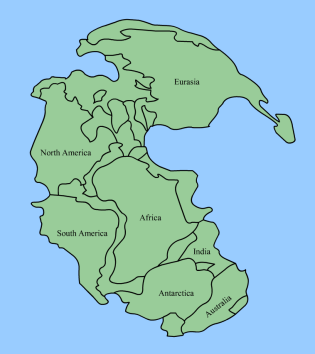
The Triassic Period (~252-201 Ma) represents a key period in Earth history and evolution, documenting the recovery from the largest mass extinction of all time (the Late Permian), the greatest extent of a single continental landmass in the form of the supercontinent Pangaea, and dramatic changes in both climate and biodiversity. It culminated with giant-scale volcanic eruptions, rapid “hyperthermal” warming and mass extinction during the Rhaetian, the terminal stage of the Triassic. Because of the similarities between the potential causes of these past catastrophic events (e.g. greenhouse gas emissions) and those predicted to affect future ecosystems, events such as the Late Triassic can be used as analogues for future extinction scenarios. It has been widely theorised that geographic and environmental parameters such as geographic range, palaeolatitude, and organismal life habits profoundly control both the survivorship potential of species and the severity of extinction rates within clades. However, these fundamental issues have rarely been tested. Therefore, it is necessary to use the geographical and ecological aspects of fossil occurrences to analyse which factors will determine species extinction or survival in the future.

My results show that, despite causing the extinction of around half of all life in the oceans, the Late Triassic mass extinction and the later and less severe Early Toarcian extinction did not cause permanent ecological upheaval (Dunhill et al. 2018). However, it took around 20 million years into the Jurassic for reef ecosystems to fully recover.
Analysis of extinction selectivity across suggests that pelagic predators and photosymbiotic organisms (i.e. corals) were most severely affected during both crises (Dunhill et al. 2018) but, however, during the Late Triassic, extinction was concentrated in the tropics whereas during the Early Toarcian mid to high latitudes appear more affected (Dunhill et al. in revision). Finally, if you wanted to survive a hyperthermal extinction such as the Late Triassic or Early Toarcian it is essential that you possess a wide thermal tolerance and a wide latitudinal range distribution as this is only significant predictor of survival across these ancient catastrophes.

References
Dunhill, A. M., W. J. Foster, J. Sciberras and R. J. Twitchett (2018). “Impact of the Late Triassic mass extinction on functional diversity and composition of marine ecosystems.” Palaeontology 61(1): 133-148.
Dunhill, A. M., W. J. Foster, S. Azaele, J. Sciberras and R. J. Twitchett (2018). “Modelling determinants of extinction across two Mesozoic hyperthermal events.” Proceedings of the Royal Society B: Biological Sciences in revision.

 DeepBio@Leeds