Royal Commission for the Exhibition of 1851 Research Fellowship

PI: Dr Alex Dunhill
October 2012-September 2015
An understanding of extinction events is critical as the current diversity crisis is heralded as the “Sixth Mass Extinction” and threatens to become as catastrophic as the “Big 5” in Phanerozoic Earth history. Can we predict which ecosystems will be most affected and which organisms are most likely to survive? The fossil record provides the only source of information for studying extinction dynamics over meaningful timescales and is key to understanding the nature, scale and likely course of the problem now facing biologists and conservationists.
Geographically widespread animals are less likely to become extinct than animals with smaller geographic ranges. Ecological theory states that a large geographic range, spanning multiple ecosystems, offers insurance against regional environmental catastrophes. However, during mass extinctions when environmental catastrophes affect the entire globe, it is claimed that this insurance is likely to become ineffectual.
The Triassic to Jurassic periods (~252-145 Ma) represent a fascinating stage of Earth history. It is characterised by the recovery from the largest mass extinction of all time at the end of the Permian, the peak of continental aggregation and initial breakup of the supercontinent Pangaea, a highly variable and volatile climate system, the eruption of the Central Atlantic Magmatic Province (CAMP), a global mass extinction event at the end of the Triassic and the subsequent rise to dominance of the dinosaurs in the Jurassic.
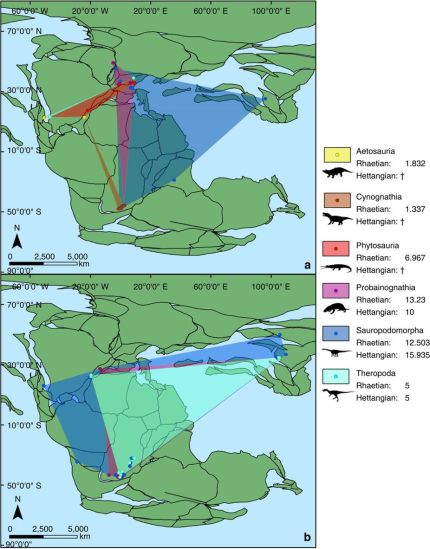
This research shows that although large geographic ranges do offer insurance against extinction, this insurance disappeared across a mass extinction event that occurred around 200 million years ago (Dunhill & Wills 2015). In the first study to analyse the relationship between geographic range and extinction in the terrestrial fossil record he found that organisms with larger geographic ranges were less likely to become extinct than those with smaller ranges during most of the Triassic-Jurassic. However, this pattern disappears near the Triassic-Jurassic boundary (around 200 million years ago) when the world experienced a catastrophic mass extinction event associated rapid climate change which caused the demise of around 80% of species on the planet.
References
Dunhill, A. M. and M. A. Wills (2015). “Geographic range did not confer resilience to extinction in terrestrial vertebrates at the end-Triassic crisis.” Nat Communications 6: 7980.

 DeepBio@Leeds